
During the initial planning phases, alternative locations at Wilhelmshaven, close to Bremen and Stade further upstream on the Elbe were also considered. Stade had the attraction that it was marginally closer to markets around Hamburg, but for the kind of shipping that will feed this mega-scale LNG terminal the mouth of the river was ultimately the more suitable location.
With phase-out of hard coal and lignite fired power stations in Germany by the end of the 2030’s, gas consumption is projected to increase. The Nordstream 2 pipeline which is currently under construction and will transfer natural gas from Russian sources to Germany will certainly help to satisfy this growth in demand. Additionally, this LNG terminal will add to the supply diversity and enable up access to US, Middle East and emerging African LNG sources. Putting the scale of the planned terminal into some context, at 240,000 cubic metres, the land-based LNG storage tank will be the biggest in Europe.
The unique advantage of LNG
In some applications, pipeline gas and re-gasified LNG are interchangeable. In others, such as the use of LNG as a fuel for ships and trucks, the energy density of liquefied natural gas sets it apart from a gaseous supply meaning that LNG terminals have a unique role to play in the energy mix of a nation. In the industrial gases industry, people will be familiar with the concept that compressed and liquefied gases are compact ways to store and transport products: the same goes for LNG. A litre of LNG is approximately equivalent to 3 litres of compressed natural gas (CNG) at 200 bar or 600 litres of natural gas at atmospheric pressure.
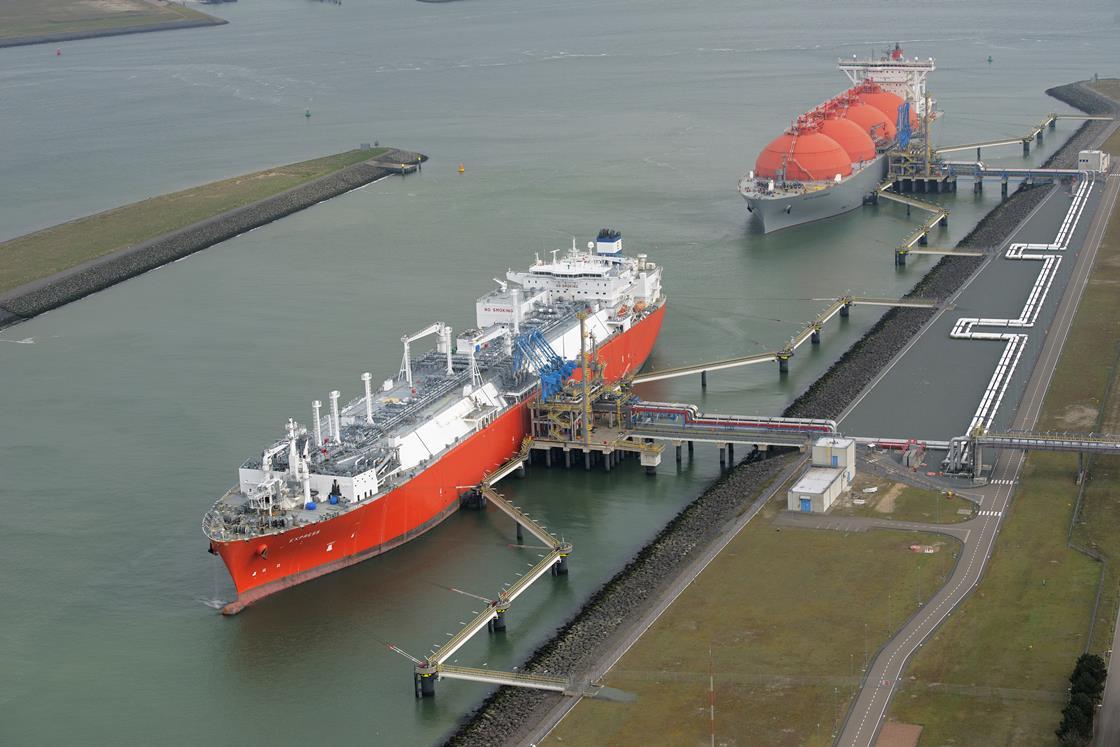
LNG terminals are an established feature of continental Europe’s North Sea ports with operations at Zeebrugge, Dunkirk and Rotterdam. So, it’s natural that Gasunie. and Vopak who operate the Gate LNG terminal in the port of Rotterdam now joined by Hamburg based Oiltanking should be playing a leading role in the development of the German LNG Terminal. Marcel Tijhuis, responsible for business development at Gasunie explains the marketing idea behind the terminal: “we see great potential to feed gas directly into the German gas grid. Beyond that, we are building in flexibility for off-grid applications. There will be two LNG truck loading bays so that trucks can collect LNG from us for distribution to ships, LNG filling stations and industrial users.
Source: Gasunie
Plans for growth
The German LNG terminal is still in the planning stage, with engineering proposals and regulatory approvals being worked through right now. Calls for EPC contractors to tender for the work to build the LNG terminal are likely to be placed later this year. Whilst the current scale of the operation will propel it into the major league, options for growth beyond that also exist. Tijhuis explains: “there is space for two additional LNG tanks, The Gate terminal that we operate in Rotterdam, has three tanks where the installed storage capacity today is 540,000 cubic metres.
“We are also seeking permits and planning for a rail terminal. One of the features that makes our LNG terminal concept unique is the flexibility of operation. We will be able to simultaneously unload from Q-Max tankers, fill into small LNG vessels, re-gasify to the grid and fill road trucks. I’m not aware of any other terminal that has such flexible operating parameters”.
The business case at Brunsbüttel goes beyond gas. There are also plans to use low grade heat from local industry to vaporise the LNG as it is re-gasified and injected into the natural gas grid. In exchange, the cold energy from the vaporisation of the cryogenic liquid will be used to provide chilled water to local businesses. Such ideas about using the cold from liquid nitrogen or liquid CO2 vaporisation will be familiar to many people in the industrial gases sector.
Brexit on the horizon?
The natural gas supply dynamic in Europe may well be impacted if Brexit negotiations complicate, or add cost, to gas exchange between the UK and continental Europe. The UK has several large-scale LNG terminals with high capacity regasification units and the pipeline infrastructure between the UK and the continent is important to help balance the demand requirements in the two locations. With these uncertainties on the horizon, this may be an additional factor influencing plans for new LNG capacity on both sides of the channel in years to come.