
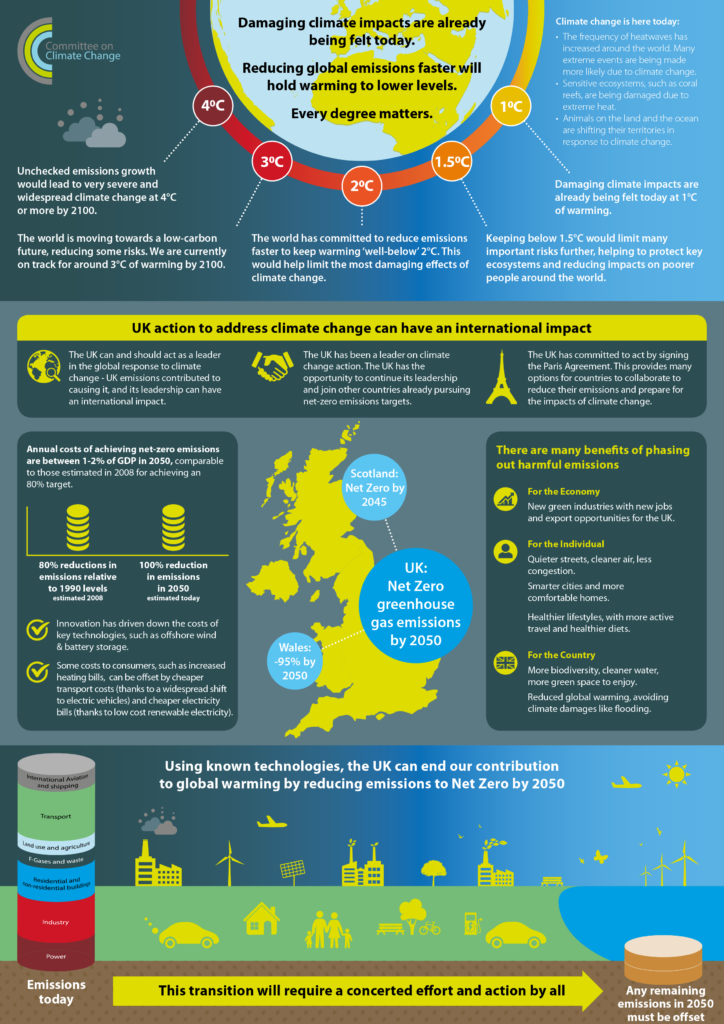

That’s the recommendation made by the UK Committee on Climate Change (CCC) in a new report published yesterday.
Achieving a ‘net-zero’ target by the middle of the century is in line with the UK’s commitment under the Paris Agreement – the pact which the UK and the rest of the world signed in 2015 to dramatically curb the polluting gases that causes climate change.
According to the report, Scotland has “greater potential” to remove pollution from its economy than the UK overall, and can “credibly adopt” a more ambitious target of reaching net-zero greenhouse gas emissions by 2045.
It says Wales has “slightly lower opportunities” than the UK as a whole and should adopt a target for a 95% reduction in greenhouse gas emissions by 2050, compared to 1990 levels.
The report recognises that reaching net greenhouse gas emissions in the UK will require important contributions from CCS in industry, for hydrogen production, combined with bioenergy (e.g. for power generation) and in flexible fossil-fired power generation, with up to 75-175 MtCO₂ being captured and stored annually by 2050.
The CCC recommends that CO₂ infrastructure development should start as early as possible, with the first CCS cluster being operational by 2026 and four more following soon after, with at least one of these clusters producing substantial amounts of low-carbon hydrogen.
As such, it identifies the development of relevant CO2 infrastructure as an important policy priority.
It also highlights the vital role hydrogen could play to achieve such a target, predicting (depending on load factor) between 6 GW (6,000 MW) and 17 GW (17,000 MW) of electrolyser capacity to be required in the UK by 2050.
ITM Power said this implies an average build rate of up to 567MW of electrolysis per annum for 30 years.
The report also covers the potential for hydrogen in reducing emissions in heating and cooking, the use in industry of green hydrogen, in fuel cell electric vehicles, in ports and in agriculture.
Welcoming the report, Guloren Turan, General-Manager of Advocacy and Communications at the Global CCS Institute said, “This report is very timely and we hope that it will be an important impetus to government, industry and other stakeholders to accelerate their efforts to deploy CCS facilities and develop CO2 transport and storage infrastructure.”
“There are many promising CCS projects in the pipeline across the UK that can bring considerable value for communities and industry.”
Source: The UK Committee on Climate Change