
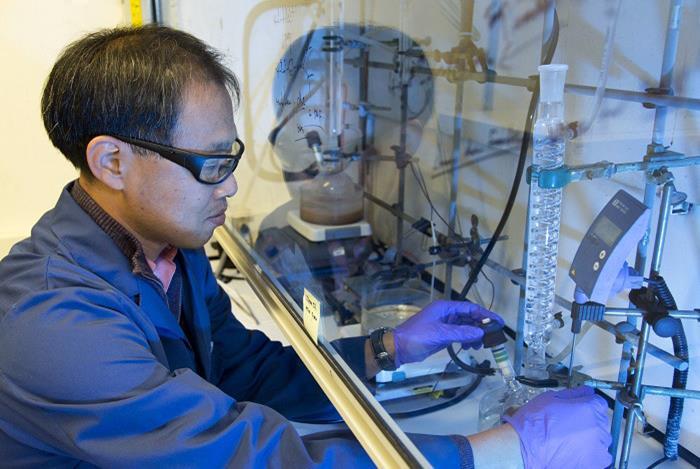
The US Department of Energy national laboratory will receive $2.9m from the Department of Energy and ARPA-E (Advanced Research Project Agency – Energy) for the three-year project which is due to begin this week.
Rensselaer Polytechnic Institute, University of Texas at Austin, University of New Mexico and Xergy will also help the lab with the project.
A fuel cell car is an electric car that will only run if the operating temperature of the engine is hydrated and below 100 degrees Celsius (212 degrees Fahrenheit). If the internal temperature goes above 100 degrees Celsius, the water will evaporate and the car won’t run.
Yu Seung Kim and his team’s job is to create a fuel cell that will allow an electric car to run without having to keep the engine cool or using water.
“This will be a very challenging project, but the reward will be great. If successful, this will change the paradigm of fuel cell technology.”
“I proposed to make a fuel cell that will work above 100 degrees Celsius, up to 230 degrees Celsius (446 degrees Fahrenheit) without using water,” Kim explained.
He said that if they could develop the fuel cells successfully, radiators in electric cars could be smaller, and even eliminated.
The radiator in a vehicle keeps the engine cool. But with the new fuel cells, the engine won’t have to be as cool, and the radiator could be much smaller.
According to Kim, a smaller radiator would make the vehicle lighter and less expensive by creating room for the fuel cell stack, which would increase the power by 20 to 30%. Using the new fuel cell technology would also allow other components such as the humidifier and demister to be removed.
The fuel cells will be made of an ion-pair coordinated polymer membrane that is designed to provide a higher rate of proton conductivity across a wide range of temperatures.
“This will be a very challenging project, but the reward will be great. If successful, this will change the paradigm of fuel cell technology,” Kim concluded.
Source: Los Alamos National Laboratory